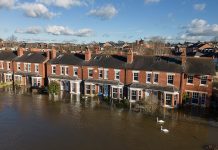










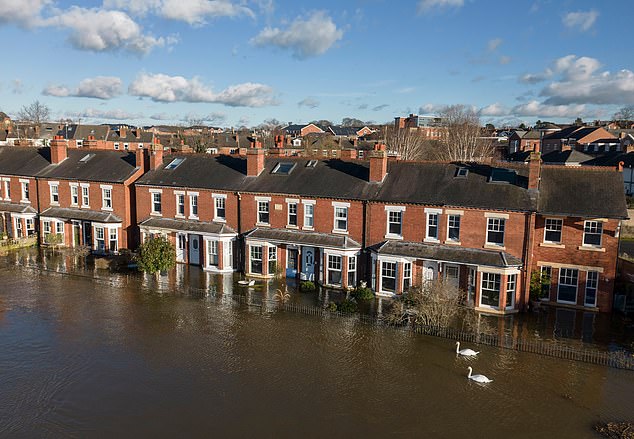


Heavy rain is expected to sweep much of Britain this week, with amber weather warnings having been issued in south Wales on Monday.
Yellow weather warnings have also been put in place for many areas in the south west and north west of England, with a month’s worth of rain expected to fall in a day in some places.
This could lead to flooding, with much of the ground already heavily saturated.
Multiple flood alerts were issued last month, and places like Monmouth in Wales have already suffered extensive flooding this winter.
More than 6.3million homes in England alone could be at risk of flooding, according to figures from the Environment Agency and Department for Environment, Food and Rural Affairs, and the threat is increasing.
In one high-profile example, comedian Ricky Gervais was recently warned by the Environment Agency that his planned £5million mansion could be at risk of suffering 1.5m high flooding that would create ‘danger of loss of life for the general public and the emergency services’.
Figures from flood reinsurance scheme Flood Re indicates that many homes could be better protected from flooding, with some 21.8million suitable for property flood resilience measures such as flood doors and raised electrics.

The installation of flood resilience measures could save £740million per year in flood damage
Is YOUR home at risk of flooding?
One way to find out is to use flood modelling – computer programs which predict whether, and how, your home could flood.
Flood modelling has come a long way in recent years, and it can be a useful tool if you are concerned that your property could be at risk of flooding, or you are buying a home in a flood-prone area. It is also used by insurers to assess claims.
Figures from Aviva indicate that the number of properties at risk could increase by 25 per cent by 2050, meaning the majority of properties in some constituencies may face flooding.
Almost 90 per cent of properties in Lincolnshire coastal district Boston and Skegness will be at risk by 2050, Aviva said, while Bermondsey and Old Southwark by the Thames in London could fare even worse with 90.4 per cent expected to be at risk.
‘Flood risks are 1764589733 much easier to spot,’ Tim Slattery, personal lines underwriter manager at Hiscox UK, says. ‘This risk can prompt insurers to scrutinise details more closely, which could in turn affect the terms and pricing of your insurance.’
To see if your home is at risk, you can use our interactive map below.
How does flood risk affect your house price?
Flood-prone areas also come with lower price tags, which can make them attractive to some buyers. However, they should bear in mind the cost of insurance and potential flood damage, and the fact that flood-prone homes can also be tough to sell on.
Angela Kerr, director of Homeowners Alliance, says: ‘You need to factor in higher insurance costs, possible difficulty getting a mortgage and a smaller pool of buyers when you come to sell.
‘It might make sense if the risk is relatively low, you can put good defences in place and the discount on the purchase price is significant.
‘But if the property has flooded before, or is in a high-risk area without proper defences, the potential costs and stress could outweigh the initial savings.’
She adds: ‘Things like location, house type, flood type, previous flood events and local demand for properties like yours are all going to matter.
‘I’d expect property value to fall more sharply immediately after a flood, with prices in affected areas taking longer to recover.’
It’s a good idea to get a specialist flood risk survey if you are considering buying a home in an at-risk area.
How can you protect your home from floods… and how much does it cost?
Protecting your home comes in two forms. Homeowners are advised to invest in flood prevention and recoverability measures to minimise damage to their property, as well as insurance to help cover the costs of any damage they do suffer.
The installation of flood resilience measures could save homeowners a collective £740million per year in flood damage, according to Flood Re, and £238million even if it was only targeted at the most frequently flooded properties.
On average, a basic property flood resilience installation costs between £1,500 and £3,000, compared with an average residential flood damage claim of £67,000, based on 2023 figures from Aviva.
Flood resilience measures can vary from barriers and non-return valves to water resistant treatments for walls and self-closing air bricks, all of which are designed to prevent water from entering your home.
Meanwhile, those in areas at risk of flooding should also consider so-called ‘recoverability’ measures, such as installing tiled floors instead of carpets, and raised electrical sockets to reduce damage in the case of a flood.
Slattery said: ‘Investing in flood resilience measures is a practical first step.
‘Consider installing flood barriers, repositioning air bricks, creating run-off areas in your driveway, or fitting flood gates to doors.
‘These steps can reduce the impact of floodwater entering your property, protect your home, and may also provide reassurance to insurers about your commitment to mitigating risk.’
‘Flood water always seeks the route of least resistance, and it is unrealistic to expect that any property can ever be entirely free from flood risk. However, you can take several cost-effective measures to buy valuable time and reduce the impact of minor flooding.’
Kerr added: ‘When weighing up the cost of installing these measures, consider that a serious flood can cause tens of thousands of pounds’ worth of damage, months of disruption and long-term effects on your property’s value and saleability.’
However, Slattery also points out how important these measures can be for your peace of mind.
He said: ‘Improvements to your property should not be weighed purely as a “cost versus benefit” calculation.
When a home floods, residents often have to move out for more than six months while repairs take place. The emotional toll can be far more significant and long-lasting than the financial cost of repairs alone.’
Anyone can sign up to Government flood alerts which give you crucial forewarning when heavy rain is predicted.
This allows you to enact any flood plan you have in place, such as moving valuables from high risk areas and ensuring you have important documents you might need if you home is flooded.
The Government also offers guidance on how to create a personal flood plan.

How can you insure yourself against flooding?
Most mortgage lenders will require homeowners to have buildings insurance to protect the property, but comprehensive insurance that covers your property’s contents will also mean that possessions are protected in the case of a flood.
Homes in flood zones are likely to come with a premium when it comes to insurance.
However, for most people in these areas, the cost will be mitigated by the UK’s Flood Re scheme.
Flood Re is a Government-backed scheme that gives homeowners in flood zones reinsurance at an affordable level. The scheme is set to end in 2039.
Slattery said: ‘It is now possible to secure flood insurance at a fixed price through Flood Re. Before Flood Re’s introduction, homeowners in these situations often faced difficulties obtaining affordable cover, so this represents significant progress in ensuring access to necessary protection.
You can also head to specialist insurers for properties that are harder to insure. The British Insurance Brokers’ Association offers a flood insurance directory.
‘It is advisable to consult your insurer regularly. Keep them informed about any upgrades or changes you have made to your property’s flood protection measures. Open communication can ensure your policy reflects the current state of your property and may help in the event of a claim.’
Slattery adds that you should keep photographic evidence of the flood measures that you have in place, as this could help if you have to make insurance claims in the future.
SAVE MONEY, MAKE MONEY

4.52% cash Isa
4.52% cash Isa
Trading 212: 0.67% fixed 12-month bonus

Sipp cashback
Sipp cashback
£200 when you deposit or transfer £15,000

Top Isa without bonus
Top Isa without bonus
Straightforward 4.55% cash Isa with no boost

£100 cashback
£100 cashback
5% cashback on investments, up to £100

£20 gift card
£20 gift card
Hold £1,000 after three months in Plum’s cash Isa
Affiliate links: If you take out a product This is Money may earn a commission. These deals are chosen by our editorial team, as we think they are worth highlighting. This does not affect our editorial independence. Terms and conditions apply on all offers.
#big #homes #flood #risk #Find #interactive #map #learn