












Rachel Reeves has been told that her claim to have cut business rates to 30-year lows was ‘misleading’.
As the bitter fallout from last week’s Budget intensified, the Chancellor last night faced mounting criticism over her tax raid on pubs, restaurants and other venues.
In her Budget, she claimed to be bringing in ‘permanently lower tax rates for more than 750,000 retail, hospitality and leisure properties’, paid for by hiking the levy on larger buildings.
Reeves said these would be ‘the lowest tax rates since 1991’.
But as more details emerged after her speech, many small businesses realised that their bills would actually go up.
And tax firm Ryan has said the Chancellor’s speech ‘just doesn’t match the fiscal reality’ as only one of the new tax rates is lower than in 1991.

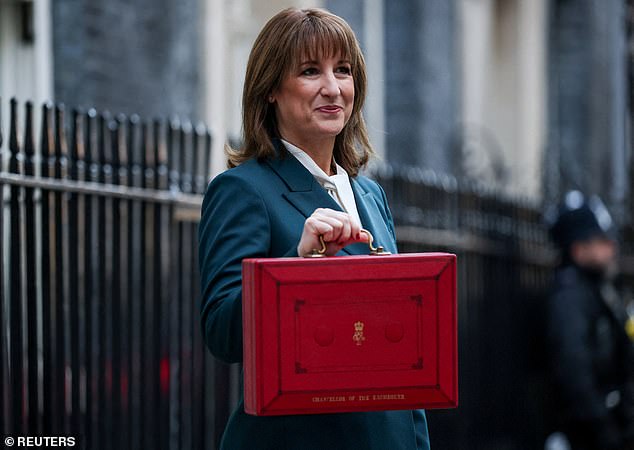
Budget boast: Chancellor Rachel Reeves (pictured) announced ‘permanently lower tax rates for over 750,000 retail, hospitality and leisure properties’
Alex Probyn, property tax expert at Ryan, said: ‘The headline message doesn’t match the fiscal reality and is misleading.
‘A large number of High Street premises will pay far higher tax rates than in the early 1990s with many facing the highest rates ever applied.’
He also accused the Chancellor of misleading the public as 750,000 is the total number of retail, hospitality and leisure firms in England.
Reeves has faced a backlash from the industry over her business rates reforms. David McDowall, the boss of Britain’s largest pub group Stonegate, said the changes had left many firms ‘with a sinking feeling’.
Anthony Pender, who runs the Somers Town Coffee House pub in Keir Starmer’s London constituency of Holborn and St Pancras said he felt ‘utterly betrayed’ by the Prime Minister.
UK Hospitality boss Kate Nicholls said: ‘The Government promised in its manifesto that it would level the playing field between the High Street and online giants. The plan in the Budget to achieve this is quickly unravelling.’
High Street firms have long complained about business rates, saying the unfair and outdated system penalises pubs and shops over online sellers.
Bills are calculated using a ‘multiplier’ and a property’s ‘rateable value’. In 1991 there was a universal 38.6p ‘multiplier’. Since 2005 there have been two rates to reflect property values.
Now, under Reeves’ complex reforms, a 38.2p multiplier for retail, hospitality and leisure properties has been introduced for some of the smallest businesses. But the other brackets are higher than 1991, with firms paying between 39.2p and 51.8p.
The Government has not said how many businesses will pay 38.2p – casting doubt on the Chancellor’s claims that she has introduced lower rates.
Reeves has denied misleading the public over the Budget.
DIY INVESTING PLATFORMS

AJ Bell
AJ Bell
Easy investing and ready-made portfolios

Hargreaves Lansdown
Hargreaves Lansdown
Free fund dealing and investment ideas

interactive investor
interactive investor
Flat-fee investing from £4.99 per month

Freetrade
Freetrade
Investing Isa now free on basic plan

Trading 212
Trading 212
Free share dealing and no account fee
Affiliate links: If you take out a product This is Money may earn a commission. These deals are chosen by our editorial team, as we think they are worth highlighting. This does not affect our editorial independence.
Compare the best investing account for you
#Misleading #Reeves #fire #business #ratesChancellor #faces #backlash #hospitality