







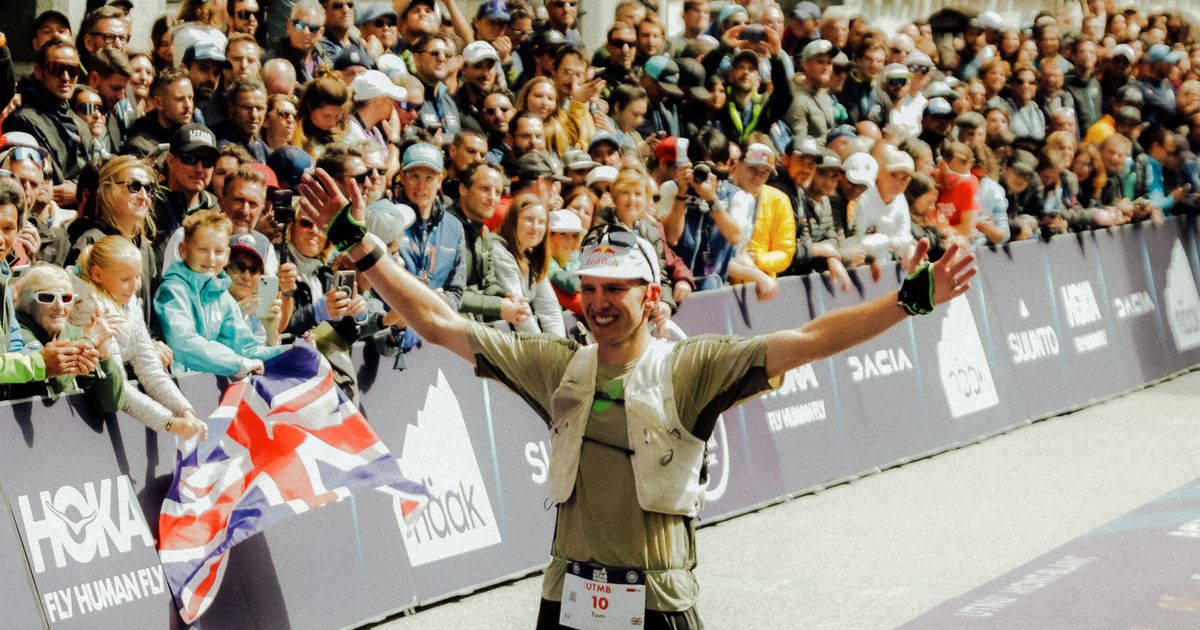


The former Army officer has become just the second British man to triumph in the legendary Ultra-Trail du Mont-Blanc. This epic 109mile race runs through France, Italy and Switzerland with 32,000ft of brutal climbing in the Alps
Tom Evans has written his name into running folklore by winning the famous Ultra-Trall du Mont-Blanc.
After failing to finish in his last two attempts, the 33-year-old took victory by completing the gruelling 175km course in a staggering 19 hours and 18 minutes.
Here he tells the Daily Star how Garmin technology, a happy soundtrack and his five-month old daughter helped him conquer one of the toughest races on the planet.
How does it feel to have become just the second British man to win this epic race?
Incredibly special. The things that don’t come easily in life are the ones that should be celebrated the most. For me, basic running I’ve always found easy. What’s taken time, effort and resources has been getting used to bad conditions in the mountains, going through the night for 20 hours in difficult terrain. So looking back at the training that I did, this result is definitely the one I am most proud of because it’s taken the most amount of hard work.
I’m quite possibly the first ever person to win it who doesn’t live in the mountains, so to have done it how I did it, in the hardest conditions that you could have had, it’s incredibly rewarding.
How tough was the weather and terrain in the Alps?
It was basically cold autumn British conditions. It pretty much rained solidly for eight hours through the night, and it was also cold and above 2,300m it was snowing so that makes it difficult.
But I think coming from a military background and coming from the UK it’s something you are fairly used to, even if it’s just a normal day out, you think ‘right what do I need to bring’. When you take that into the mountains, into a running perspective, nothing really changes. So where we did really well as a team was we adapted to the conditions, every time I saw my crew at aid stations I changed some of my kit, I would get dry, I would get warm, rather than just race through.
This year definitely suited the British athletes, but just because you are British it doesn’t mean you like the rain. It was still incredibly miserable at points.
What tech do you use and how does it help your performance?
Predominantly for racing and my key runs, I use the Garmin Enduro 3 watch, which is super lightweight and the battery life is incredible. But for day to day training I use the Fenix 8. I’ve just started using the Fenix 8 Pro with the built-in inReach technology, which means it has LTE and satellite tech, so you can send messages through it even if you haven’t got your phone or any phone signal.
I’ve not had to use the SOS feature on it before, but it’s incredible tech that I’d much rather have and not need, than not have it and wish I had it. It’s a game changer for endurance athletes doing challenges in extreme and remote environments. I also use the HR600 heart rate monitor.
Another area I like to keep track of is my sleep – and I use the Garmin Index Sleep Monitor for that. I wear it instead of my watch at night and it tracks your sleep, so in the morning I’ll wake up and look at that data and see how I feel and plan my training around this.
Something else we use is Garmin Index scales to measure my sweat rate. My trainers and I need it to see how much water I need to drink every hour by weighing myself just before I start running, then measuring how much liquid I consumed during the run, then weighing myself afterwards. Every product has helped during training and with my performance in the race.
Did you make any changes to your approach after failing to finish in the previous two years?
Yes, two main changes. Firstly we just trained way more specifically for the race. We had a customised treadmill that goes to 25% incline, probably the only one in the UK, which allowed us to replicate the longer climbs and bigger mountains on the course. Normally over a winter i’ll do some cross country or some road races, whereas last winter I spent most of my time either in the Lake District or Peak District and on the treadmill which was fairly boring but I think that’s why I found this so rewarding. Its shown me you can find a way.
Secondly on the mental side the big difference was I didn’t feel like I needed to win. For the two years when I didn’t finish, I felt like I had to win to validate that I was good. But this year there was so much more going on, Phoebe our daughter is the most important thing in my life and added a lot of perspective. The only thing that I need to do is be a good father and that’s my number one goal. Yes I want to win these races, but that’s exactly it, I want to do it, so I didn’t feel any stress or pressure going into the race.
My strength really lies in the second half of the race so the plan was to get to that point feeling relatively good (well as good as you can after running 60 miles). One way we did this was by using my Garmin watch to set my paces. The uphills are the most taxing on your body, so I used the Climb Pro feature which shows you the gradient, how far up you are and how much longer you’ve got to go.
That allowed me to sink into an effort, so I knew if I had another 3km of climbing and I was feeling tired then to back off, and also when to push on. I also measure my heart rate to make sure I don’t go over a certain rate. In previous races i’ve gone too hard at the beginning, so this time it was a case of staying calm because I knew the second half of the race was when I was going to be at my best.
What mental strategies do you use to keep going during the toughest moments?
Sometimes it can be really complicated trying to set up mental strategies to help performance. I have been working with a neuroscientist called Dr David Spindler. We reverse-engineered it and said when do I perform my best – when I’m my happiest. So we were like, let’s just keep you happy.
My daughter Phoebe is starting to find her voice and she is making lots of funny squeaking and almost howling noises and I have started howling at her like a wolf would at the moon. So we said when I feel bad at night, stop for a second and howl at the moon because that will bring back the memories of me doing that with Phoebe and it will put a smile on my face. This will then release the endorphins to make me feel happy and stay positive. We also used memories or a note from my wife, little things like that.
Another thing I used this year was music, I had headphones that had an mp3 built into them. So during the night, when it was dark and cold, I had a really happy soundtrack, Greatest Showman-esque with songs like Pink Pony Club because it just puts a smile on your face. Being happy for me is so key to performance. I tried doing it the hardcore way of going into my ‘pain cave’ and just digging it out, but for me, being happy in the moment is the most important thing.
Sharing your victory with your wife and baby daughter must have been very special. Is being a dad changing you as an athlete?
It’s been the most incredible journey and it’s helped put some perspective into life. It’s so easy to get bogged down in small intricate details. If you are supposed to run at 4min per km and you run 4.05min per km, in the grand scheme of things it’s not the end of the world, you get home and you have still done what you needed to.
Phoebe is the most important thing in my life, and it makes me even more thankful to be out when I’m running. I enjoy it even more knowing that I’m doing it because I want to do it, not because I need to do it. I need to be the best dad I can possibly be. So one thing that’s changed is travelling and going away on training camps. I won’t go on another one this year. I don’t want to be an absent parent.
Is it hard to navigate at night in the pitch black?
You’ve really got to stay concentrated and focused. It can be easy to be in a world of your own and then miss a turning. The last thing you want to do is to take a wrong turn, go downhill and then realise you’ve got to climb all the way back up to get back on course because that is just miserable! I have got lost In the past, so taking your time to make sure you know the course is important. For all my races I have the course saved onto my Garmin watch and it beeps and vibrates if I go off course.
For UTMB, I know the route so well because I’ve run it in training so many times. I’ve also got a really good headlamp. All of the markers are reflective so it’s almost easier to navigate at night than it is during the day.
As a professional athlete I’m fortunate be able to go and spend two months in the Alps, learning the course. But even if you don’t know the course there are other things you can use such as Google Maps to plot a flyby so you can see where the climbs are and where the downhills are. And unless you are at the front, you can follow people’s headlamps, although following blindly is probably not a wise idea.
What do your eat while running for nearly 24 hours?
A real mixture, probably 60/40 ratio of gels to real food. I make rice cakes with sushi rice and mix it with Nutella or biscoff, so you get a good mix of carbohydrate and a little bit of fat as well. I think doing really long races off gels alone is tricky, its all fairly sweet so to add some savoury in makes a big difference. What I tend to find is that I get to the standard meal times and I want to eat something because that’s when you are used to eating. So making sure you eat at those points is pretty important.
Are you worried about the long term effects of running such huge distances?
There is so much contradictory science out there, where some people are saying running is bad for your knees, but other people say it’s good for your knees, I think if you can look after your body then I don’t see why you can’t keep doing this for a long time. I think mentally its probably more challenging, you can get burnout, constantly chasing something that may or may not come. That’s probably what I’m a bit more worried about.
How do you counter that? You stay happy and keep chasing the things that interest you. I spend a lot of time looking after my body whether that’s in the ice bath or the sauna. As long as I can do that, plus keep my mind in check, then yeah it should be fine.
What are your plans for the rest of the season?
There’s a 80km race called the Sainté-Lyon in France in November that is of interest to me. I’ve also got a place at the Valencia Marathon in December. I’ve got a big itch to scratch running the marathon, so I will see how my body is in the next few weeks and take it from there.
#Ultrarunner #Tom #Evans #tells #Garmin #tech #baby #girl #helped #win #runnings #Super #Bowl