












A record proportion of second-hand car buyers are choosing pure electric models, new figures published on Monday show.
Britons snapped up 80,614 used EVs between July and September, the Society of Motor Manufacturers and Traders (SMMT) confirmed in its latest market report.
It means EVs accounted for one in 25 second-hand car transactions (4 per cent) this summer, up from 2.8 per cent in the same three-month period in 2024.
A total of 2,021,265 used car transactions were recorded in the three months to the end of September, up 2.4 per cent from a year earlier.
However, SMMT chief executive Mike Hawes warned that the Government plans to make vehicles obtained through Employee Car Ownership Schemes liable for company car tax could restrict the availability of used EVs and hamper the switch to electric motoring.
The motor industry body has also criticised the reported introduction of pay-per-mile taxation for EVs from 2028, which is due to be announced in Chancellor Rachel Reeves’ Autumn Budget statement later this month.

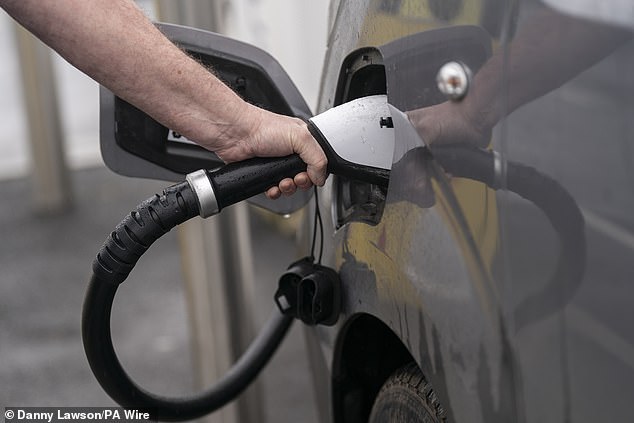
Britons snapped up 80,614 used EVs between July and September, the SMMT confirmed in its latest market report
Petrol remained the best-selling fuel type among second-hand buyers, with transactions rising 1.9 per cent to 1,145,148 units between July and September.
In contrast, the used diesel market contracted by 2.8 per cent to 658,664 sales.
Transactions of conventional – self charging – hybrid cars rose by 30 per cent to 107,727 vehicles, while plug-in hybrids grew by 2 per cent to 23,480 second-hand sales, the official data shows.
Yet, despite the increase in availability and demand for used electric and hybrid vehicles, internal combustion engine cars still account for nine in ten pre-owned motors changing hands across the country.
But the SMMT has warned that the broader availability of quality ‘nearly-new’ year-old used motors could potentially become far more limited ahead of new rule changes set to be announced by the Chancellor.

Of all second-hand car transactions over the summer, 4% were EV models. That’s up from 2.8% over the same period in 2024

It says 99,313 cars under a year old – a third of them electrified – changed hands in the last three months.
And many of these will have entered the used car market via employee car ownership schemes (ECOS) available to workers within the nation’s automotive sector.
But this supply of the latest – greener – cars will be ‘severely impacted’ by the Government’s plans to levy company car tax on ECOS vehicles, which would see new car registrations fall by around 80,000 units a year, it estimated, as it warned that and access to more sustainable motoring would be restricted.
‘With used EV uptake at a record high, a robust used car market is essential for fleet renewal, and helps make electrified mobility more accessible for more motorists,’ SMMT chief executive, Mike Hawes, said.
‘However, overall consumer choice and affordability are at risk if the government scraps ECOS, a move that would stifle supply of the very latest vehicles into the used market and cut Exchequer revenue.’
The body has also spoken out on the impact of Ms Reeves’ plan to introduce pay-per-mile taxation on EVs from 2028.
It would see all electric car owners charged 3p for every mile they drive on top of existing Vehicle Excise Duty rates, which currently stand at £195 a year.
The contentious move is aimed at recovering some of the lost revenue expected when more Britons switch to EVs, which will see fuel duty on every litre of petrol and diesel dry up for Treasury coffers.
A spokesperson for the Society of Motor Manufacturers and Traders told the Daily Mail last week ‘We recognise the need for a new approach to motoring taxes but at such a pivotal moment in the UK’s EV transition, this would be entirely the wrong measure at the wrong time.’
They added: ‘A smarter, fair and future-ready taxation system requires a fundamental rethink – one that must be done in full partnership with the industry and other stakeholders.’
Commenting again today, Hawes stated: ‘Britain needs fiscal policy that promotes rather than prevents economic growth, social mobility and decarbonisation.’
#cars #bought #summer #electric #secondhand #market #grows