










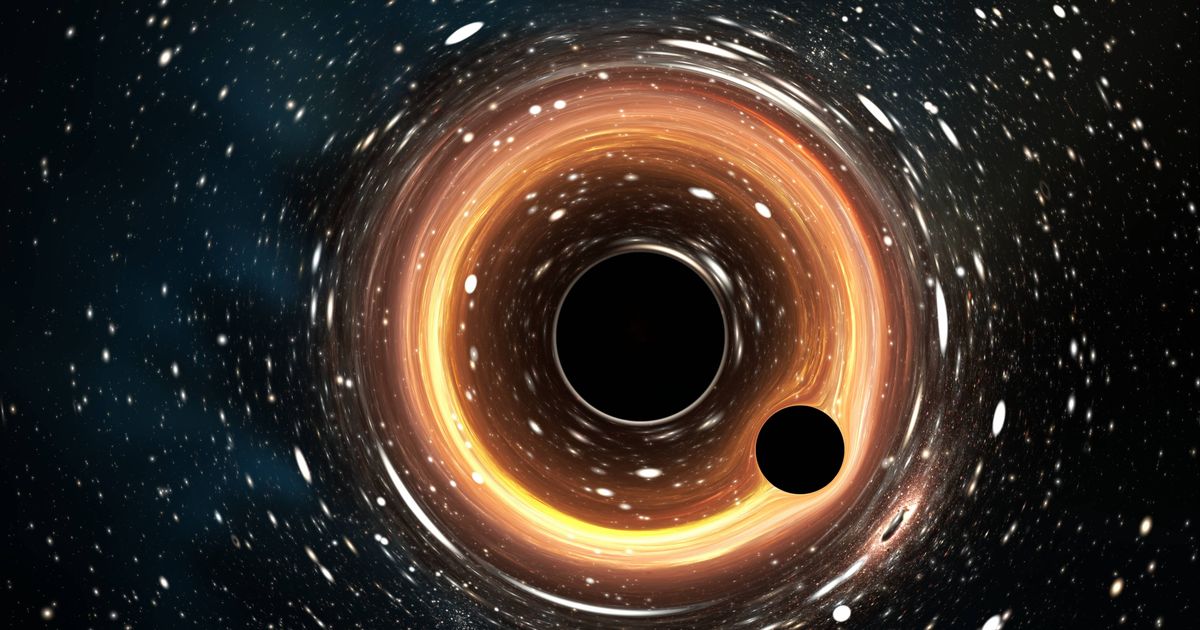


Astronomers have discovered that supermassive black holes are not as massive as previously thought, after examining an infant galaxy 12 billion light years from Earth for the first time
Supermassive black holes aren’t quite as colossal as scientists previously believed, groundbreaking research has revealed.
Astronomers from the University of Southampton, collaborating with European colleagues, have peered into an infant galaxy situated 12 billion light years away using cutting-edge telescope technology for the first time.
Their findings showed that the supermassive black hole within this distant galaxy was actually 10 times smaller than anticipated, suggesting that researchers have been overestimating black hole dimensions throughout the cosmos.
Professor Seb Hoenig explained that these results have cracked a long-standing scientific conundrum regarding how supermassive black holes managed to reach such enormous proportions in relatively brief timeframes.
He stated: “We have been wondering for years how it’s possible we discovered all these fully grown supermassive black holes in very young galaxies shortly after the big bang. They shouldn’t have had the time to grow that massive.
“Our results suggest the methods to weigh these black holes used previously are just not working reliably in the early universe.
“It could lead to a re-evaluation of our models of cosmic evolution.”
The breakthrough study, featured in the journal Astronomy and Astrophysics, utilised the sophisticated Gravity+ instrument, which merges light from four of the planet’s most powerful optical telescopes at the European Southern Observatory’s Very Large Telescope in Chile.
The research team, comprising scientists from France, Germany, Portugal and Belgium, studied an ancient quasar which they described as “a galaxy with a black hole so old and bright it looks like a cosmic beacon from the dawn of time”.
Their investigation revealed that the quasar possessed a swirling movement of scorching gas with a mass 800 million times that of the sun, destined to be consumed by the supermassive black hole.
Prof Hoenig explained: “Most of the gas falling towards the supermassive black hole is being violently blasted away rather than feeding it.
“Think of it like a cosmic hairdryer set to maximum power: the intense radiation around it is blowing everything away that approaches it.”
The researchers clarified that this particular movement was crucial for achieving the accurate measurement of the black hole’s mass.
The academics assert that this “feeding frenzy” generates a forceful expulsion of gas which might have misled earlier studies into overestimating the actual size of the black hole.
#Astronomers #find #supermassive #black #holes #massive #previously #thought