













Britain’s high borrowing costs are giving the Chancellor a headache, but pension savers can turn Rachel Reeves’ misfortune to their advantage by locking in a higher income.
The rise in yields on long-term gilts, as UK government bonds are known, has driven up the rates offered by pension firms on annuities, a financial product that provides a guaranteed income for life.
A healthy 65-year-old with a £100,000 pension pot can now secure income of around £7,800 a year compared with £7,100 a year ago, according to best buy data from Hargreaves Lansdown.
That is a near 10 per cent increase in annual income and the rise in rates has led to pension firms reporting renewed interest in taking out annuities.
A product aiming to match inflation has seen an even bigger proportional jump in its payout. An annuity with payments that rises 3 per cent annually can generate £5,800 a year, against nearly £5,100 a year ago – a near 14 per cent rise in income.

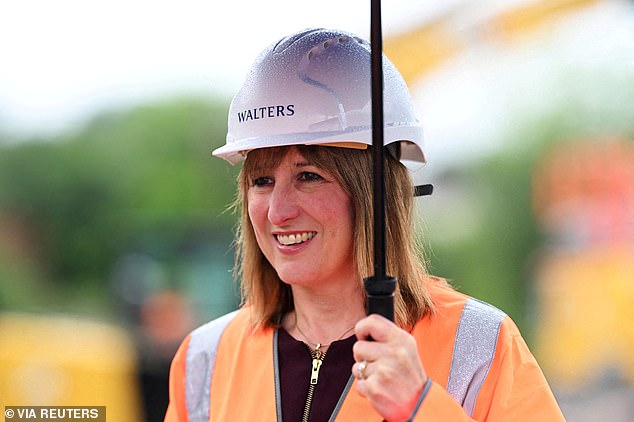
Taking shelter: Pension savers can use the rise in government borrowing costs to their advantage thanks to higher annuity rates
Helen Morrissey, head of retirement analysis at Hargreaves Lansdown, says that its average fund used to purchase an annuity was £162,729 in the first six months of 2025. That is a big increase from £62,301 when rates were at a low four years ago
She says the trend busts the myth that annuities only appeal to those with smaller pensions, as those with larger pots are also making use of annuities as part of their retirement strategies.
‘The higher incomes currently available will have made them a more tempting prospect for people with larger pensions who have decided that now is a good time to get a guaranteed annuity,’ she says.
Is it time for more retirees to consider an annuity rather than remaining invested and drawing on their pension? We explain what you need to know.
What is an annuity?
Savers with defined contribution schemes will have built up an investment pot that they must turn into retirement income.
The two main options are to leave your pension invested and draw on it for income, or to use the pot to buy an annuity. You can also do a combination of the two.
Annuities provide a guaranteed income until you die. Their pricing is heavily influenced by the interest rate, known as the yield, offered by long-term gilts.
Annuities are a large and long-term purchase, and you can’t change your mind afterwards, so are not something to buy on a whim after a market upset.
Those in ill-health can get higher rates, while savers should also consider if they want to leave an income to a spouse or partner after death. Fixed-term annuities can also be bought, which provide income only for a set period and then some money back.
> Essential guide: How to turn a pension into retirement income
Bond market trouble and better annuity deals
Higher borrowing costs are a headache for the Government but also mean higher yields for institutions like big pension firms willing to lend it money.
The turmoil in the bond markets is down to fears Chancellor Rachel Reeves is losing her grip on the public finances at home, alongside wider global issues, including President Donald Trump’s attacks on the Federal Reserve in the US, and a debt crisis in France.
These ructions led to the yield on 30-year gilts – long-term UK debt – hitting a three decade-high of 5.75 per cent a few weeks ago before falling back to around 5.50 per cent.
That’s bad news for the Chancellor ahead of November’s Autumn Budget but enables pension firms to fund more attractive rates for people wanting a safe income from an annuity in old age.
Are annuities worth buying again?
Interest rate rises in recent years have led to a resurgence in interest in annuities after a long period when they were mostly shunned by retirees as poor value and restrictive.
Since pension freedom reforms in 2015 removed the need to buy an annuity, most people have opted to keep their pension fund invested and live on income taken from it instead, despite the risks from financial market volatility.
But there are halfway house options available. There are various ways to combine annuities with investment drawdown, such as buying a fixed term annuity – which provides a guaranteed income for a set period of time – for example to fill a gap from early retirement until state pension age.
Another is to use income drawdown to fund early retirement and then buy an annuity for safety and less hassle monitoring investments in later life.
This strategy allows you to wait to see if annuity rates improve further and potentially take advantage of better rates if your health deteriorates as you grow older.
You can also combine drawdown and an annuity at the same time. That lets you secure a minimum level of guaranteed income to cover essential household bills with an annuity, while keeping the remainder of your pension invested with the potential for further growth and the ability to withdraw regular or ad hoc sums.
William Burrows, financial adviser at Eadon & Co, says the yield on 30-year gilts has been at its highest since 1998.
He says: ‘Consequently annuity rates are at their highest level for many years. It might make sense to take less investment risk with your pension pot and secure an annuity at these high levels.
‘For some people it may make sense to arrange annuities in slices as they get older and need more income security and want to take less risk.’
Choose your annuity carefully
Morrissey suggests looking carefully at the types of annuities available to make sure you get the right type for you.
‘A level annuity may give the highest starting income, but it won’t rise every year like an inflation linked product. A single life annuity will also not make provision for a spouse or civil partner when you die.’
Meanwhile, you have the option to buy a guarantee period that ensures your family doesn’t lose the entire amount paid upfront if you die a few years after buying an annuity.
Daniel Swift, head of financial planning at TrinityBridge, says higher interest rates in recent years have meant people pay more attention to annuities, but demand is still below levels seen before more flexible retirement options became widely available following pension freedoms.
‘Our planners discuss annuities with clients in terms of their strengths – such as guaranteed income – and their drawbacks, including inflation risk if payments remain fixed,’ he says. ‘But the decision rarely comes down to rates alone.’
He explains that while fluctuating rates can spark conversations, whether a client chooses an annuity depends far more on their individual circumstances, goals, health, access to alternative savings, and risk appetite.
Swift adds: ‘Taking out an annuity is a final and fixed decision, which suits some people very well. But with pension rules and tax legislation continually evolving, many prefer to retain some flexibility and keep their options open if circumstances change.’
SIPPS: INVEST TO BUILD YOUR PENSION

AJ Bell
AJ Bell
0.25% account fee. Full range of investments

Hargreaves Lansdown
Hargreaves Lansdown
Free fund dealing, 40% off account fees

Interactive Investor
Interactive Investor
From £5.99 per month, £100 of free trades

InvestEngine
InvestEngine
Fee-free ETF investing, £100 welcome bonus

Prosper
Prosper
No account fee and 30 ETF fees refunded
Affiliate links: If you take out a product This is Money may earn a commission. These deals are chosen by our editorial team, as we think they are worth highlighting. This does not affect our editorial independence.
Compare the best Sipp for you: Our full reviews
#profit #Rachel #Reeves #misfortune #locking #bigger #pension #income