











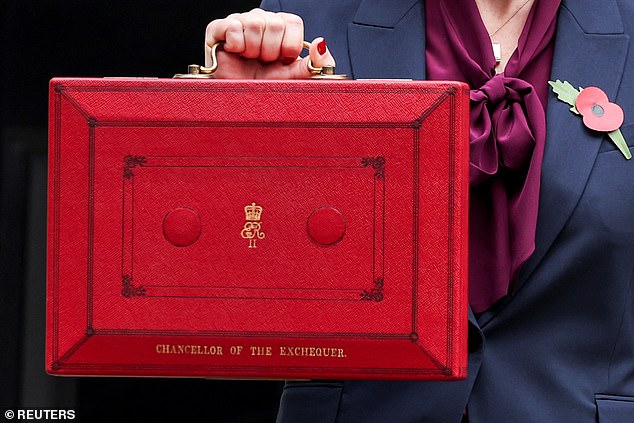


The are two weeks to go before Chancellor Rachel Reeves unleashes a blistering tax assault on us all in the Budget.
It’s going to be financial hell, for sure. But, dear reader, this is not the time to cower and wait for the worst to happen.
Now is the moment to ensure your household finances and long-term investments are sufficiently robust to withstand Ms Reeves’ attack.
Yes, most of us will be poorer post Budget than we are now as a result of higher taxes on our pay or retirement income. It’s nigh on unavoidable. Also, our wealth is going to be compromised as a result of extra taxes on our pensions and investments.
Yet, by taking a few simple steps in the coming days, you can build a layer of resilience into your finances and investments to take some of the sting out of the Chancellor’s tail.

Now is the moment to ensure your household finances and long-term investments are sufficiently robust to withstand Ms Reeves’s attack
STEP ONE
The best starting point is to review your household finances: don’t groan, you’ll thank me post November 26 (Budget Day).
So, may I suggest you sit down with a cup of Tetley’s finest, search out your most recent bank statements (preferably going back a year) – and list the regular payments being taken from your account. (Apologies to those readers who already do this.)
These payments will cover everything from broadband, council tax, electricity, gas, insurances, through to the mortgage, other loans, mobile phone, subscriptions, and water.
Then ask yourself a simple question: ‘Can I get better value for money?’
And, where the services are non-essential (for example, a subscription to a film streaming provider), do I really need them?
Some payments will be non-negotiable (your council tax bill, for example). But a majority won’t be, giving you leeway to find a better deal.
Maybe not straightaway and maybe not until post Budget, but certainly in the months ahead.
So, if you’ve got a home loan, is it possible to get a cheaper one by remortgaging? Speak to your provider or a mortgage broker who will do the sums for you.
If you are on a fixed or discounted rate deal, ensure you make a note to shop around ahead of it coming to an end. Don’t just take the new product offered by the current provider.
Although premiums for car and home insurance are falling, reducing the propensity for people to shop around at renewal, don’t renew quietly.
Use a comparison website to see if cheaper cover is available elsewhere – and either switch or go back to your existing insurer and barter. Some will match the price you’ve found elsewhere.
The same tactic applies to broadband and TV packages. Existing providers will invariably reduce their renewal price if you find a more attractive package elsewhere and threaten to leave.
Also, see if you can get a cheaper energy supplier by shopping around.
As for subscriptions for services you no longer use (a fitness app, for example, or a music streaming provider), note the date of auto-renewal and cancel (providers are now required to let you know in advance when a subscription is due to renew).

The best starting point is to review your household finances: don’t groan, you’ll thank me post November 26th (Budget Day)
Finally, if you’re a low water user, consider a meter. For those who live alone or own a house with more bedrooms than occupants, it could (not will) cut your bills. Speak to your supplier.
STEP TWO
If you have cash savings – or money sitting in a bank account – they need to work to your financial advantage, not the provider’s.
That means your cash should be delivering half decent interest and much of it should be shielded from tax.
The best home for savings (not money for household emergencies) is a tax-free cash Isa. Look upon it as your own mini tax-free haven.
Currently, you can squirrel away up to £20,000 a tax year in a cash Isa. That means a maximum of £40,000 per couple.
But this cash Isa allowance is likely to be cut in the Budget to £10,000 per person, with the reduction kicking in from the tax year starting April 6, 2026.
For those using Isas to invest (see below), they will keep the £20,000 annual allowance and be able to use it exclusively to buy shares and funds – or split it between a stocks and shares Isa and a cash Isa (subject to the £10,000 cap).
So, if you are a saver rather than an investor, use as much of this year’s existing £20,000 allowance as you can – ensuring you pick a provider paying an attractive rate of interest.
Yet, you also need to ensure that the cash Isas you have accumulated along the way are also earning attractive interest. If they are not, transfer them to a new provider which offers a better rate.

If you have cash savings – or money sitting in a bank account – they need to work to your financial advantage, not the provider’s
Interest from savings held outside of a cash Isa is protected by the annual personal savings allowance, worth £1,000 for basic rate taxpayers and £500 for those paying 40 pc income tax (additional rate taxpayers don’t get an allowance).
For couples where one pays 20 pc income tax, the other 40 or 45 pc tax, it makes sense that household savings utilise the basic rate taxpayer’s larger allowance.
One other consideration on tax-efficient saving. Don’t dismiss NS&I’s Premium Bonds lightly. All monthly prizes – ranging from £25 to £1million – are tax-free and the annual prize rate is currently 3.6 pc.
Those aged 16 and over can hold up to £50,000 of bonds – and purchases are permitted by post and phone as well as online.
STEP THREE
For those investing for the long term, investment growth is the key to success. But tax can nibble away at profits if the investments are not held inside a stocks and shares Isa.
In last year’s Budget, the Chancellor immediately raised the tax rate on capital gains made from share or investment fund disposals from 10 to 18 pc for basic rate taxpayers – and from 20 to 24 pc for higher rate taxpayers.
The only concession is that Ms Reeves kept the annual capital gains tax (CGT) exemption at £3,000.
Capital gains taxes could rise again on November 26 given that many Labour MPs believe they should be aligned with income tax rates.
But what is more likely is an increase in tax rates on dividend income which are levied respectively at 8.75, 33.75 and 39.35 pc for basic, higher, and additional rate taxpayers.
As with CGT, there is an annual tax exemption, worth £500.
For investors, you have several options available between now and the Budget.
You could sit tight. Or you could take tax-free profits from the sale of shares up to the current £3,000 CGT exemption.
It’s an approach that might appeal to investors unnerved by fears of an impending stock market crash. You could bank even more profits, paying CGT at rates which in a couple of weeks’ time might (not will) be higher.
Alternatively, if committed to long term investing, you could rearrange your investments to be as tax efficient as possible.
For example, you could use a process called ‘Bed and Isa’ to move some existing shareholdings into your tax-friendly Isa.
It involves the sale of the shares followed by them being bought back straightaway inside your Isa. The amount that goes into the tax wrapper counts towards your annual £20,000 allowance while the ‘bedding’ (sale) of the shares will be tax-free if below the £3,000 CGT exemption.
It sounds complicated, but if you use a broker or an investing platform, they will do the donkey work. You can also do ‘Bed and pension’ where the shares end up in your tax-friendly pension.

Labour despises inherited wealth. Last year Ms Reeves announced a curtailment in inheritance tax reliefs available to those who want to pass on assets such as farms and private businesses
Jason Hollands of wealth manager Evelyn Partners says another savvy tactic is to transfer investments to your spouse, especially if they are on a lower income tax rate.
Shares disposed of later by the spouse will more than likely attract a lower CGT bill than if they had still been held by you as a higher rate taxpayer.
Such interspousal transfers, again arranged by your broker or investing platform, are tax-free. Mr Hollands says: ‘By rearranging your investments in such a way, you have at your disposal two sets of annual tax-free dividend allowance and CGT exemption. Plus, two Isa allowances. You are reducing the family bill.’
STEP FOUR
With an attack on tax-free pension cash now ruled out, it seems the Chancellor will use the Budget to curb the use of so called ‘salary sacrifice’ pension arrangements by employers.
These are schemes set up in such a way to cut National Insurance bills for both workers and employers.
Experts believe that while a crackdown on salary sacrifice is a given, it won’t come in immediately: next April at the earliest. Nor for that matter will any other changes such as a move to a flat rate of relief on pension contributions.
‘Keep paying into your pension,’ urges Sarah Coles, head of personal finance at Hargreaves Lansdown.
It is echoed by Charlotte Kennedy of wealth manager Rathbones. ‘Making use of your annual pension allowance [a whopping £60,000] remains good practice,’ she says, ‘irrespective of what the Budget brings.’
STEP FIVE
Labour despises inherited wealth. In last year’s Budget, Ms Reeves announced a curtailment in the inheritance tax reliefs available to those who want to pass on assets such as farms and private businesses.
It also confirmed the inclusion of unspent pension assets in estates from April 2027, a move which will drag tens of thousands more households into the IHT net.
Yet Labour hasn’t finished with IHT. On the cards is a clampdown on the amount you can give away during your lifetime – and it could come in the Budget.
There are numerous allowances that can be used to pass on wealth before you die, helping mitigate a future IHT bill.
These include an annual gift allowance of £3,000 that can be made to one person or several people. Also, if you didn’t use the allowance in the tax year ending April 5 this year, you can utilise that too. This means you and our spouse could pass on £12,000 to friends and relatives.
Annual ‘small’ gifts of £250 can also be made to any number of other people.
Such gifting is straightforward, but you must keep records of when they were made, to whom and their amount.
Between now and the 26th of this month is as good a time as any to be kind to those you love.
AND FINALLY…
Ensure you have a medicinal glass of something strong available on the 26th.
You’ll need it. Mine will be a glass of single malt scotch whisky from Islay.
#days #stop #Rachel #Reeves #Budget #wrecking #finances #Times #short #money #guru #JEFF #PRESTRIDGE #Act #lose