













The majority of UK motorists support the installation of breathalyser in new cars to reduce repeat drink-driving, a new study has found.
Alcohol interlock devices, also known as ‘Alcolocks‘ or ‘ignition locks’, prevent a vehicle’s engine starting if there’s alcohol in the user’s breath sample that they’re required to provide before every journey.
Four-in-five (82 per cent) of 2,395 UK licence holders polled by the RAC said they would be an effective measure to prevent drink-driving in real-time.
Support for the interventionist approach has been growing, with 53 per cent of drivers telling the RAC in May that they want the Government to allow courts to order anyone convicted of drink-driving to have these breathalysers installed in their cars.
Drink-drive reoffending is a serious issue – since 2010, 17 per cent of offences have been committed by someone with a previous drink or drug driving offence on their record.
The Government is expected to announce measures to tackle the problem in its forthcoming Road Safety Strategy, which is likely to include a requirement for all new cars to feature equipment to enable breathalyser installations.

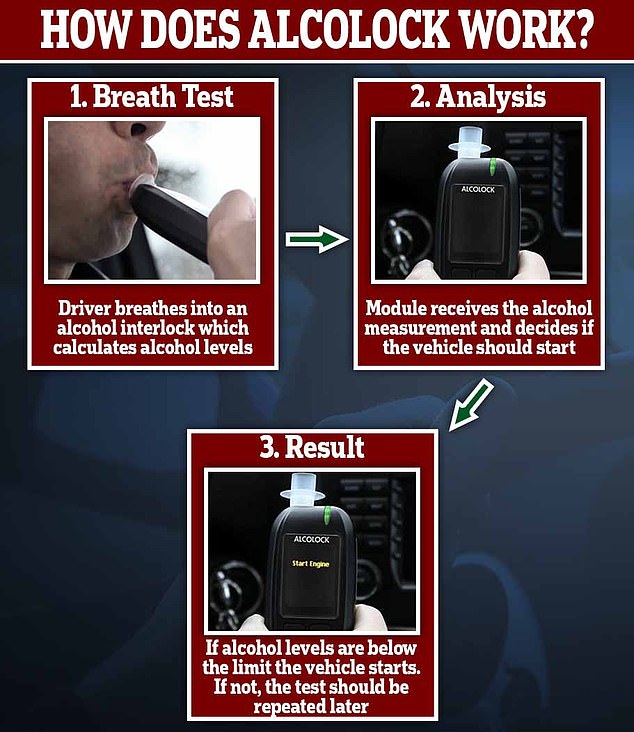
This is how alcolocks will work to prevent previous drink-drive offenders from starting a car’s engine without first providing a legal sample of breath
Of those drivers supportive of the use of alcolocks, the RAC found that as many as seven-in-10 think every driver caught over the legal limit should have to have one fitted to their vehicle.
A further quarter think only repeat drink-drivers caught on at least one previous occasion should be ordered to have them installed, with six per cent unsure.
Overall, just seven per cent against alcolock use and 12 per cent undecided, the RAC’s survey found.
Young drivers are the most supportive of the anti-drink driving method, with 87 per cent of those under 25 backing the move. Some 86 per cent of those aged 25 to 44 are also keen to see them rolled out.
But 75 per cent of drivers aged over 65 are also in favour – showing across all age groups the idea is well received.
The level of support is due to the serious and deadly consequences drink-driving can have.
The latest Department for Transport (DfT) figures show an estimated 260 people were killed in crashes on Britain’s roads involving at least one driver over the legal alcohol limit in 2023. Approximately 1,600 people were seriously injured.
A Freedom of Information request to the DVLA by the Press Association found 27,000 individuals were convicted of multiple drink-driving offences in the 11 years leading up to July 2024.
And research for the RAC Report on Motoring 2025 also uncovered that rates of admitted drink-driving are near pre-pandemic levels, with more than one-in-10 respondents saying they’d driven when they thought they were over the limit, either directly after drinking or on the morning after.
The figures for younger drivers were higher with 14 per cent of those aged 25-44 admitting to drink driving, and as many as 18 per cent of those under 25.

Four-in-five of 2,395 drivers survey by the RAC said interlocks would be an effective measure to prevent drink-driving in real-time
RAC road safety spokesperson Rod Dennis said: ‘With levels of drink-driving still alarmingly high, drivers are very keen for something different to be done to tackle the problem.
‘Giving courts the power to mandate the fitting of alcohol interlocks – which prevent a convicted drink-driver from getting behind the wheel after drinking – is something that drivers believe warrants serious consideration as they’re telling us the current penalties aren’t working.
‘The fact a huge majority of drivers support the use of alcolocks sends a clear message that they want to see more being done to tackle drink-driving, something the Government will hopefully address in its soon-to-be-published Road Safety Strategy.’
Could alcolocks become standard? What are they and how do they work?
Alcolock is actually a brand name – founded in the 1970s – but has become the common name for breathalysers fitted to the car’s ignition system.
Once fitted a driver has to provide an alcohol-free breath sample in order to start the engine – usually blowing for five seconds.
If there’s little to no alcohol the engine will start. If it exceeds a set level it won’t start.
There are various options as to how they’re mandated and who pays for them.
Courts could mandate them for reoffenders only, or anyone convicted of drink-driving.
In most countries where they’re already used, the installation is generally paid for by the offender, although in cases of financial hardship the state can step in to cover the cost.
However, it’s worth noting that the EU introduced new rules in July 2024 requiring all new cars sold in the EU to be ‘prepared’ to have an alcolock fitted.
The UK is set to follow this same order, which will be included in Labour’s long-awaited Road Safety Strategy.
Where are alcolocks already in use around the world?
Alcolocks are used in Finland, Belgium, New Zealand, Australia, Canada and many parts of the US.

Alcolock is a brand name (its V3 version pictured) but has become the term for all breathalyser ignition locks
Generally, in these countries drink-drivers are banned for a short time and then are allowed to drive again as long as they have an alcohol-interlock fitted to their vehicle for a set period. It’s usually fitted for a year.
In New Zealand, the alcohol-interlock is removed after 12 months as long as the offender had no instances of alcohol in their recorded breath tests during the last six months.
Those that test positive have to keep the device until they have six months of tests with zero alcohol.
Offenders are then issued with a zero-alcohol driving licence for three years.
#Fourinfive #motorists #cars #fitted #breathalysers #crackdown #drinkdrivers