












Toyota has unveiled the ninth generation of one of its all-time best-selling vehicles which has been snapped up by more than 21 million customers worldwide – and confirmed it will be going electric for 2026.
Famous for being ‘indestructible’ when Jeremy Clarkson failed to destroy one as part of a memorable Top Gear feature 20 years ago, the model has been a reliable workhorse loved all around the world for 53 years.
But in 2026 the Toyota Hilux will enter a new era, with the Japanese company announcing it will sell a full-electric variant alongside a conventional diesel model.
And it won’t stop there; by 2028, bosses also confirm there will be a hydrogen fuel cell version too, making the legendary Toyota pick-up one of the greenest commercial vehicles on the market.
Executives said the new generation of its ‘global icon’ will continue to offer ‘strength, reliability and lasting quality’ despite its newfound electrification.
But new taxation rules imposed by Rachel Reeves in April will make the truck less appealing to Britons.

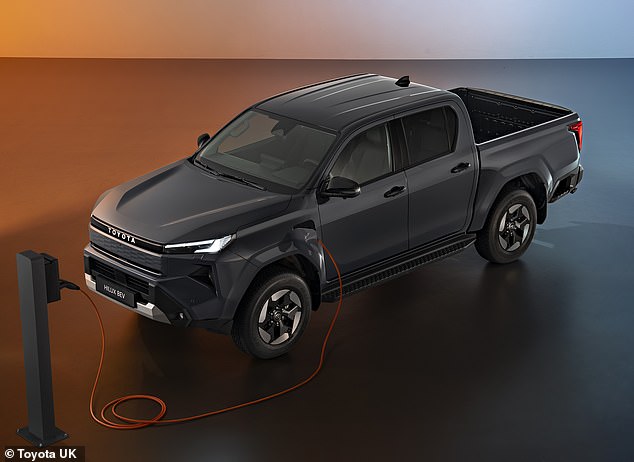
This is the new ninth-generation Toyota Hilux – and it’s available as an EV. Despite its newfound electrification, bosses are adamant it will continue to offer ‘strength, reliability and lasting quality’
Confirmation of an EV and hydrogen fuel cell variant of the new Hilux is part of Toyota’s ‘multipath philosophy’ to give customers ‘multiple powertrain options to best meet their needs and local driving conditions’.
The most popular in Europe – and worldwide – will be the diesel, which will be available first from around the middle of next year.
However, even this powertrain has absorbed a form of electrification and will be sold exclusively with mild hybrid support.
It will use the same 2.8-litre 48V setup used in the current Hilux, featuring a small 48-volt lithium-ion battery – which is located under the floor beneath the rear seats as to not compromise interior space – and an electric motor to support the combustion engine.
Toyota says it will deliver ‘smooth, quiet and refined performance’ in both on and off-road driving and despite its electrification retains a 700mm wading depth.
In this more conventional guise, it will be able to carry up to one tonne in its bed and tow braked trailers up to 3,500kg in weight.

The Japanese company on Monday announced a full-electric Hilux BEV that will be sold alongside a mild-hybrid diesel. And it won’t stop there; by 2028, bosses also confirm there will be a hydrogen fuel cell version, too


The Hilux has been available across eight generations dating back to 1972. Toyota has sold over 21 million examples globally since then
Its capabilities off-road will be bolstered by Toyota’s ‘Multi-Terrain Select’ system – the first time a Hilux gets this clever setup.
At the switch of a button, drivers can optimise the vehicle’s characteristics – including throttle response, traction control, and braking – for a number of specific surface types: mud, sand, rock, dirt, or deep snow.
There’s an ‘auto’ mode too, which automatically detects the driving conditions and spares drivers from needing to switch between different adaptable settings.

The most popular in Europe – and worldwide – will be the mild-hybrid diesel option, which will be available first from around the middle of next year

Motorists will be able to tell it apart from the EV variant by its grille, with the Hilux BEV having a flush panel across its face


In this more conventional diesel guise, the new Hilux will be able to carry up to one tonne in its bed and tow braked trailers up to 3,500kg in weight. The Hilux BEV doesn’t match these capabiities – in fact, it can tow less than half the maximum weight of the diesel
But the big talking point is the fully electric Hilux BEV [Battery Electric Vehicle] variant, which will rival other EV pick-ups sold in overseas markets, namely the Ford F150 Lightning and Rivian R1T in the US.
Toyota says the move into the EV market is a ‘breakthrough innovation for Hilux’ without sacrificing ‘any of the model’s renowned quality, durability and reliability’.
It uses a 59.2kWh lithium-ion battery and a pair of e-motors – one on each axle – to provide permanent all-wheel drive.
But range will be limited at ‘approximately 150 miles’ between charges.
While this is well short of the 300-mile average for new models arriving in 2025, it should still be enough for a hard day’s graft on farmland and general use away from the tarmac.
Toyota too says it will have ‘best-in-class charging capabilities’ to minimise vehicle down-time, though has yet to reveal how quickly the batteries can be replenished.
While the front electric motor generates 205Nm of torque, it will be slightly rear bias with the back axle putting out 268.6Nm.
Toyota says ‘tentative’ data based on its prototypes suggest it will be able to carry 715kg on weight – 285kg less than the diesel – and have a 1,600kg towing capacity, which is less than half what the conventional 2.8D can haul.

The Hilux BEV has a 59.2kWh lithium-ion battery and a pair of e-motors – one on each axle – to provide permanent all-wheel drive. But range will be limited at ‘approximately 150 miles’

Toyota too says it will have ‘best-in-class charging capabilities’ to minimise vehicle down-time, though has yet to reveal how quickly the batteries can be replenished

While this is well short of the 300-mile average for new models arriving in 2025, it should still be enough for a hard day’s graft on farmland and general use away from the tarmac
Like the diesel, it uses the Hilux’s signature ‘body-on-frame’ construction with its primary focus on off-road performance.
Specific measures have also been put in place to protect the battery from damage and water ingress, which means the Hilux EV matches the 700mm wading depth offered by the combustion-engine variant.
It also gets the Multi-Terrain Select system. But while the diesel’s off-road controls are grouped on the interior centre console for ease of operation, the Hilux EV uses a single-action shift-by-wire drive selector.
The 2026 model is the first Hilux equipped with electric power steering, providing ‘more direct operation, easier manoeuvrability and less risk of kick-back when driving over uneven ground,’ Toyota says.
The Mk9 Hilux will also boast a suite of new assisted driving safety technology.
Toyota continues to back hydrogen fuel cell tech
The Japanese car giant has been one of the front runners in terms of bringing hydrogen fuel cell vehicles to market, having launched two generations of its Mirai FCEV in Europe.
However, steep pricing of £50,000 plus and a limited hydrogen filling station network has stunted its demand, especially against electric rivals like the Tesla Model 3, which is around £10,000 cheaper.
While these have been available in the UK since 2015, DVLA records show that just 88 are registered in Briton.
Yet, Toyota UK confirms that a hydrogen fuel cell electric Hilux is scheduled to arrive in 2028.
‘The fuel cell Hilux will be a further demonstration of Toyota’s commitment to realising the potential of hydrogen as a valuable source of clean energy and will add stimulus to a wider roll-out of hydrogen eco-systems and infrastructure in Europe,’ the company said, though has yet to reveal any further details of the powertrain and its capabilities.

Toyota’s electrification of the Hilux doesn’t end with the BEV; by 2028, it will also sell a hydrogen fuel cell variant

‘The fuel cell Hilux will be a further demonstration of Toyota’s commitment to realising the potential of hydrogen as a valuable source of clean energy and will add stimulus to a wider roll-out of hydrogen eco-systems and infrastructure in Europe,’ the Japanese marque said
A ‘tough’ look to go with its indestructible
Toyota says a new design for the ninth-generation Hilux is aimed at retaining its famous ‘tough’ identity.
This was dramatically bolstered by the Top Gear season six feature where Clarkson and sidekicks James May and Richard Hammond went to great lengths to attempt to destroy an ageing Hilux in an extreme durability test.
Having purchased the vehicle from a farmyard with 190,000 miles on the clock, the Toyota was running without issue, though showing some signs of corrosion on the body.
But to see if it was the most robust motor on the planet, it endured a number of ‘tests’ at the hands of the Top Gear presenters to see if it could be registered undrivable.
This included sending it down a flight of steps, crashing into a tree, and submerging it in the Bristol Channel to the point it needed to be winched free.
It was also dropped from a crane, driven head-on at speed into a wooden structure, hit with a wrecking ball, had a caravan dropped on top of it from a height, and set on fire.
Yet, using basic tools, the Hilux started after minor repairs.

In 2005, BBC’s Top Gear attempted to permanently disable a Toyota Hilux, to no avail

The pick-up truck was crashed through a wooden shed at speed as part of the extreme BBC Top Gear test

The team even set the truck alight as part of the durability test of the Hilux, which has for a long time been regarded as one of the most durable vehicles of all time

Clarkson and co left the Hilux in the sea in Bristol (pictured), clobbered it with a wrecking ball and even dropped a caravan on top of it from a height

Even after falling from a 23-storey block of flats that was demolished, the Hilux’s engine started after a little fettling by a team of mechanics using basic tools

Such was its feat of endurance, the wrecked vehicle was displayed as a decoration piece in the Top Gear studios for future seasons
Having far failed to permanently disable the Hilux op to that point, Clarkson went to a new extreme, arranging for the vehicle to be placed on the roof of a 23-storey building scheduled for demolition.
Following the explosive scene, the Hilux was recovered from the rubble showing significant body and mechanical damage.
With mechanics on hand again to see if they could spark the engine back to life, the diesel motor astonishingly started, with the Hilux victoriously limping into the Top Gear studio to a huge round of applause from the live audience.
Such was its feat of endurance, the vehicle was displayed as a decoration piece for the future seasons.
Toyota continues to play on that unbreakable reputation by giving the new Hilux a powerful front end that gives the ‘visibly strong stance’ customers and businesses want from a pick-up truck.

The reworked cockpit now has a central infotainment screen up to 12.3-inches and a digital and customisable driver’s instrument cluster

The simple cabin layout is dominated by a new portrait centre console unit housing the adaptable driving surface settings
The redesign includes new slimmer headlight clusters that are connected by a central bar carrying the Toyota name badge.
With the EV not requiring the cooling benefits of a traditional grille, it instead has a flush panel across the front to tell it apart from the diesel.
It also rides on a unique alloy wheel design.
New features for all versions include a new rear deck step for easy access, while higher trim levels get a redesigned side step to make it aid occupants getting in and out.
The reworked cockpit now has a central infotainment screen up to 12.3-inches and a digital and customisable driver’s instrument cluster.
Owners and businesses will also have access to remote and connected services using the MyToyota app.
For fleet operators, they will be able to track up to 10 Hilux using the application, which provides information about their location, fuel level and EV charging status, and driving analytics such as journey history.

BiK tax changes introduced by Chancellor Rachel Reeves are likely to restrict appetite for the new Hilux. We explain why…
Rachell Reeves tax change threatens Hilux demand in the UK
Toyota has confirmed the new generation Hilux will be sold exclusively as a double cab variant, which is said to be ‘in line with customer preference’.
But for Britons, this could be a problem.
It means every Hilux will fall into a higher Benefit in Kind (BiK) company car tax band following changes introduced by the Chancellor earlier this year, with double cab pick-ups treated as ‘cars’ from 6 April.

Double cab pick-up trucks – which have five seats like a conventional family motor – had been popular amongst labourers because they previously qualified for fixed BIK rates for ‘commercial vehicles’. But under new tax rules introduced by Rachel Reeves, they’re now classified as cars and are therefore subject to higher taxation
This means they will be taxed on CO2 emissions and the vehicle’s list price and will no longer benefit from low fixed BIK rates or eligible for tax relief claims.
The previous tax loophole had made it affordable for builders, farmers and traders to have a vehicle that can double as a personal car as well as a haulage vehicle, with the double cab providing seating for a family of five.
But with double cab pick-ups now subject to 37 per cent BIK rates, compared to previous fixed BIK rates for ‘commercial vehicles’ of £3,960 regardless of emissions or price, it will almost certainly restrict demand for the new Hilux in Britain.
Ford – which makes Europe’s best-selling pick-up, the Ranger – slammed the Government’s changes earlier this year, with a spokesperson telling the Daily Mail: ‘The change in taxation to double-cab pick-up vehicles for benefit-in-kind and capital allowance purposes is a rash move by the Government that will have a big impact on UK business’.
#truck #Jeremy #Clarkson #couldnt #kill #returns #Toyota #unveils #electric #version #indestructible #vehicle