











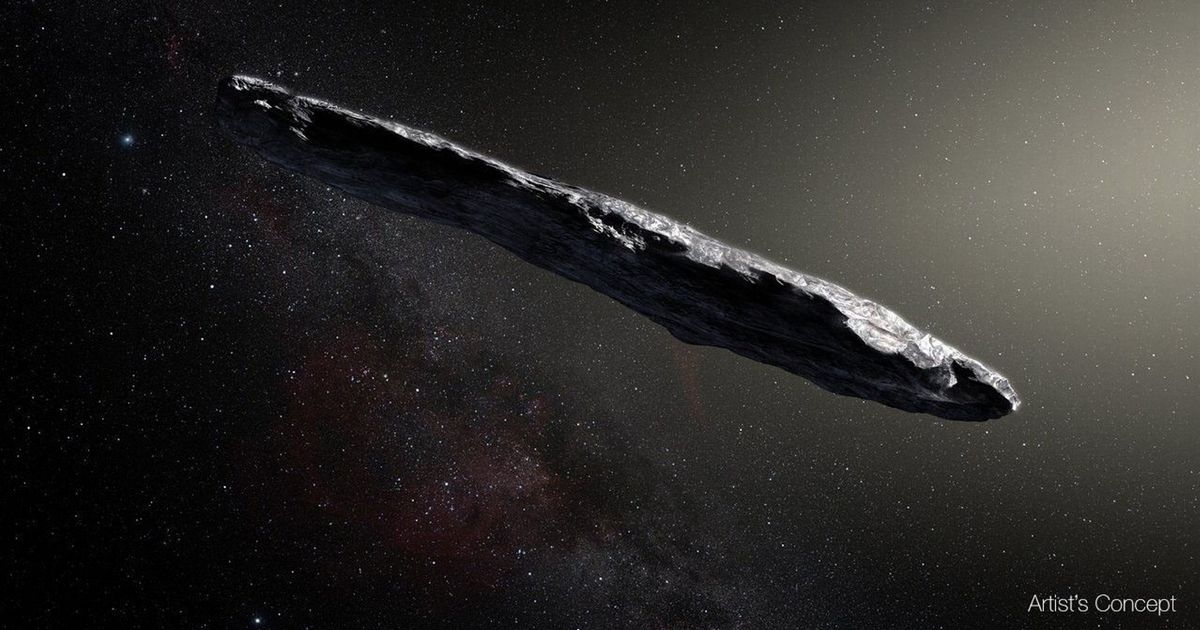


A new paper has discussed how the 3I/ATLAS comet could have one final meeting with a major planet before it veers out of our reach for good, but it is still uncertain
New research reveals that the infamous 3I/ATLAS comet may have one final encounter before it bids farewell to our solar system for good in 2026. By focusing on ‘dynamic simulations’ of the interstellar object, the research paper analyses the course 3I/ATLAS will take on departure.
Astronomers are still not sure where 3I/ATLAS came from in the first place, with some suggestions that it may have come from the Milky Way’s ‘thick disk.’ It was first spotted in July 2025, with some experts believing that it could be a spacecraft. It comes after the man who claims a comet is an alien spaceship alleges that alien contact with Earth will be confirmed by 2030.
Separately, Chris Lintott, Professor of Astrophysics and Citizen Science Lead at the University of Oxford, said: “This thing’s coming in much faster than the other two, but it is actually within the range of velocities that we would predict in objects.
“So we don’t think that’s notable, but it’s moving fast up and down relative to the plane of the galaxy in a vertical velocity, so it gives us a clue about where it’s from. Our model predicts that it’s from a star in the thick disc of the galaxy.
“[Comet 3I/ATLAS] is probably from an old star in the thick disc, and we think that it’s likely that this thing’s been out there for longer than the age of the Solar System.”
The new paper attempted to model the direction that 3I/ATLAS came from and where it is headed to try and map a rough path.
The team wrote: “The long-term orbital integration of 500 statistical clones of comet 3I for hundred years in the past and future shows that the comet is coming from the Sagittarius constellation with a mean radial velocity of -57.995 ± 0.011 kms−1 and leaving towards the Gemini constellation with a mean radial velocity of 58.01 ± 0.01 kms−1.”
The team also looked at close encounters that the interstellar object will have before it heads out of our reach, and wrote: “The comet 3I will definitely suffer the perturbation from both Mars and Jupiter at their respective close approach epochs.
“The effect of Jupiter will be larger due to the fact that the comet is passing very close to the Hill radius of Jupiter.
“The distance of the comet 3I from Jupiter is very close to the Hill radius (0.355 au) of Jupiter. Therefore, there could be a stronger perturbation from Jupiter compared to Mars.”
It seems that on March 16, the interstellar object could have a course-altering encounter with our largest gas giant, Jupiter. However, it’s non-gravitational acceleration means that it is still uncertain what will actually happen.
For the latest breaking news and stories from across the globe from the Daily Star, sign up for our newsletters.
#Alien #spaceship #3IATLAS #change #experts #predict #huge #planet #crash