
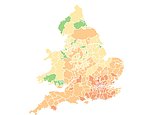













Houses are actually getting more affordable across Britain despite prices hitting all-time highs.
Last year, 9.1 per cent of authorities in England and Wales had a house price-to-disposable income ratio below five.
This marked a 20-year high, with the equivalent figure in 2004 at 16.7 per cent.
All of the affordable authorities were scattered across the North, Midlands, Scotland and Wales.
Nowhere in the South scored below the affordability threshold of five, according to annual figures kept by the Office for National Statistics (ONS).
The equivalent ratio in one part of London even exceeded 35.
Experts say the number of ‘affordable’ homes, which almost doubled between 2023 and 2024, was fuelled by wage growth and a stagnating market.
Lancashire’s Ribble Valley saw the biggest dip over the last two decades, dropping 1.97 points.
Median house prices there in 2024 (£263,000) were, however, still six times greater than the average salary, of around £43,044.
Behind Ribble Valley, in terms of the authorities which registered the biggest drop in affordability ratios, came Ceredigion in Wales (-1,68), followed by North Kesteven in Lincolnshire (-1.54).
The ONS house price-to-earnings ratio is calculated by dividing house prices in an area by the median annual earnings of its residents.
Last year, the typical home in Kensington and Chelsea sold for £1,200,000 – 35 times the average annual salary for residents in the area £42,120.
That ratio has soared by 15.48 points between 2004 and 2024, more than anywhere else in the country, although it is still down on its 2017 peak when it tipped 50.
Westminster saw the second biggest jump in unaffordability (up 10.44 points), ahead of Hammersmith and Fulham (9.71).
London boroughs accounted for 24 out of the 25 biggest unaffordability rises with only Hertfordshire’s Dacorum, which includes the leafy towns of Hemel Hempstead and Tring, bucking the trend at number 25 (4.53).
Experts say the trend illustrates how would-be homeowners have been priced out of the capital.
Adam Rolfe, policy and public affairs officer for financial consultancy Money Wellness, said: ‘The dramatic fall in affordable housing isn’t just a statistic – it reflects how wages and house prices have become completely disconnected over the last 20 years.
‘Since 2003, average earnings have risen much more slowly than property prices, meaning even modest homes now cost many multiples of what people earn.
‘And at the same time, the supply of new, genuinely affordable housing has failed to keep pace with demand, with fewer social and starter homes being built.
‘Demand has also risen sharply; more households are forming, more people want to live near cities and jobs, and investors have often been competing with first-time buyers.
‘Add in higher mortgage rates and stricter lending rules in recent years, and buying has become out of reach for many.’
Labour set a target for 1.5 million new homes to be built in this Parliament, or 300,000 a year.
London is expected to deliver 440,000 of them.
Under current rules, up to 35 per cent of the capital’s newly-built stock needs to be classed as ‘affordable’. Yet it was reported last week that this target could be slashed to 20 per cent in efforts to boost housebuilding.
The ambitious plan was overseen by Angela Rayner, who was deputy prime minister and housing secretary until she resigned over her second home tax scandal.
By flooding the market with stock, ministers hoped a housebuilding blitz would drive down purchase prices and rental fees.
But construction analysts argue that Labour’s task is ‘near impossible’, with planning permission for new homes having tumbled to an all-time low. Around 200,000 homes are being built each year currently.
Under the targeted approach, homes will be constructed on Britain’s green and grey belts.
The so-called grey belt consists of previously developed land which does not contribute to the key aims of the green belt of preventing urban sprawl and protecting the countryside.
Labour previously described grey belt as ‘poor quality’ and ‘ugly’ areas.
But housing policy hawks have long called for the need for house building to ramp in the face of a growing number of people settling in Britain from overseas.
Matt Hutchinson, director of flatshare site SpareRoom, said: ‘Chronic undersupply has long been a problem in the private rental sector.
‘There has never been enough stock to keep pace with demand and as homeownership declines, the number of renters rises, putting further pressure on limited supply and forcing up rents.
‘The pandemic caused lasting damage to the rental sector which the UK still hasn’t recovered from, rents were pushed to record levels and though demand eventually returned to normal, room rents didn’t correct.’
Chris Curtis, Labour MP for Milton Keynes North, said: ‘The correct answer to the problem is to build as much affordable housing as we can.
‘But if we ask for too much of each new project to be affordable housing, that can lead to the project becoming unviable and then everyone is left with nothing.
‘People understand supply and demand with every other product in their lives – it works for housing even more.
‘At the minute there is just too much red tape everywhere that is making it too difficult to build.
‘I hope the Government are looking at streamlining the building services regulator and improving slower planning decisions to really get things moving.’
A spokesperson for Sadiq Khan said: ‘The mayor and Secretary of State met recently to discuss the challenging conditions facing housebuilding in London.
‘The disastrous legacy and underfunding from the last government led to record construction costs, high interest rates, and lengthy delays from the Building Safety Regulator, which created a perfect storm leaving the capital facing the worst conditions for housebuilding in decades.
‘Sadiq will always prioritise getting as many affordable homes built as possible – and has shown that by completing more new homes of all tenures in London than any time since the 1930s prior to the pandemic, tens of thousands of genuinely affordable homes across the capital, and more new council homes started than any time since the 1970s.
‘The mayor is working with the Housing Secretary on a package of reforms to boost housebuilding in the capital.’
It comes after figures in September revealed UK house prices rose to a record high of just shy of £300,000. Halifax said the housing market was stable.
#UKs #affordable #areas #named #area #fare